
The Complete Digital Marketing Guide for Startups: Strategy, Channels & Growth (2026)
Every startup has the same problem: you need customers, but you have almost no money to find them.This guide gives you a proven digital marketing strategy built specifically for early-stage startups — with a 90-day roadmap, India-relevant channels, INR budget benchmarks, and AI tools that let a team of two compete with a team of twenty.By the end, you will know exactly which channels to prioritise, how much to spend, and what to do in your first 90 days to start generating leads.
Quick Answer (AI Mode): Digital marketing for startups means using online channels — SEO, social media, email, and paid ads — to attract, convert, and retain customers without a large budget. The most effective approach is to pick 2–3 channels matched to your audience, build a 90-day roadmap, and scale only what works.
Every startup has the same problem: you need customers, but you have almost no money to find them.
This guide gives you a proven digital marketing strategy built specifically for early-stage startups — with a 90-day roadmap, India-relevant channels, INR budget benchmarks, and AI tools that let a team of two compete with a team of twenty.
By the end, you will know exactly which channels to prioritise, how much to spend, and what to do in your first 90 days to start generating leads.
Table of Contents
- What Is Digital Marketing and Why Do Startups Need It?
- How Do Startups Do Digital Marketing? (The 90-Day Roadmap)
- The Best Digital Marketing Channels for Startups in 2026
- How to Build a Startup Marketing Strategy on Any Budget
- AI Tools That Give Startups an Unfair Marketing Advantage
- Common Digital Marketing Mistakes Startups Make
- Frequently Asked Questions
- Conclusion
What Is Digital Marketing and Why Do Startups Need It?
Digital marketing is the use of online platforms and tools — search engines, social media, email, and websites — to promote a business, attract customers, and drive revenue. For startups, it is not optional. It is the only cost-efficient way to reach customers at scale before you have the budget for traditional advertising.
Unlike large brands that can spend ₹50 lakh on a TV campaign, a startup can run a targeted Instagram ad for ₹500 per day and reach exactly the right audience in exactly the right city. That asymmetry is why digital marketing for startups in India has become the single most important growth lever in 2026.
Three reasons startups specifically need digital marketing:
- Measurability: Every rupee spent can be tracked to a lead, a click, or a sale — no guesswork
- Speed: A blog post or ad campaign can go live in hours, not weeks
- Scalability: What works at ₹5,000/month can be scaled to ₹50,000/month without rebuilding from scratch
Takeaway: Digital marketing is the only marketing channel that lets a startup with ₹10,000/month compete against a brand spending ₹10 lakh/month — if the strategy is right.
 Takeaway: Digital marketing is the only marketing channel that lets a startup with ₹10,000/month compete against a brand spending ₹10 lakh/month — if the strategy is right.
How Do Startups Do Digital Marketing? (The 90-Day Roadmap)
Startups do digital marketing most effectively by following a phased roadmap: build the foundation in the first 30 days, activate 2–3 core channels in days 31–60, and optimise based on data in days 61–90. Trying to run every channel from day one is the fastest way to waste budget and burn out your team.
Here is the exact 90-day roadmap:
Days 1–30: Build the Foundation
- Set up Google Analytics 4 and Google Search Console — you cannot improve what you cannot measure
- Claim and complete your Google Business Profile — free, high-visibility, and critical for local searches
- Publish your first 3 SEO blog posts targeting low-competition, high-intent keywords in your niche
- Set up your Instagram and LinkedIn pages — complete bios, profile photos, and cover images
- Build a basic email capture — a simple landing page with a lead magnet (checklist, free guide, or discount)
- Install Meta Pixel on your website — even if you are not running ads yet, the pixel starts building your audience data from day one
 CWV Note: Ensure your website loads in under 2.5 seconds (LCP). A slow site cancels out all marketing efforts — use Google PageSpeed Insights to check.
Days 31–60: Activate Your Core Channels
Pick two or three channels based on your audience (see the channel matrix below). Do not spread across five channels. Go deep on two.
- SEO: Publish 2 blog posts per week. Target “how to” and “what is” keywords with low difficulty
- Instagram Reels / LinkedIn content: Post 4–5 times per week. Prioritise Reels — organic reach is still high in 2026
- WhatsApp broadcast list: Build a list of 100–500 early customers or leads. Send one value-packed message per week — no spam
- Meta Ads (optional at this stage): Start with ₹200–300/day retargeting website visitors. Do not run cold audience ads until you have at least 500 website visitors/month
Days 61–90: Optimise and Double Down
- Check Google Analytics: which blog posts are getting traffic? Write 3 more on the same topic cluster
- Check Meta Ads: which ad creative got the lowest cost-per-click? Kill the others and increase budget on the winner
- Check email open rates: which subject lines got above 25% open rate? Replicate the format
- Build one piece of “pillar content” — a comprehensive guide (like this one) targeting your most important keyword
The Best Digital Marketing Channels for Startups in 2026
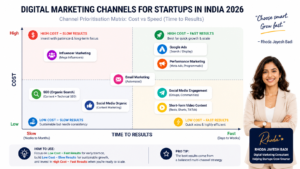
The best digital marketing channels for startups in 2026 are SEO, Instagram/Reels, WhatsApp marketing, and Meta Ads — in that order for most Indian B2C startups. B2B startups should replace Instagram with LinkedIn as the primary social channel.
ere is the full channel prioritisation matrix:
| Channel | Setup Cost | Monthly Cost (INR) | Time to Results | Best For |
|---|---|---|---|---|
| SEO / Blog | Low | ₹0–15,000 | 3–6 months | Long-term organic traffic |
| Instagram Reels | Low | ₹0–5,000 | 2–8 weeks | B2C, D2C, lifestyle brands |
| WhatsApp Marketing | Very Low | ₹0–3,000 | Immediate | Repeat customers, local businesses |
| Meta Ads (Facebook/Instagram) | Medium | ₹6,000–30,000 | 1–4 weeks | Scalable lead gen, e-commerce |
| Google Ads (Search) | Medium | ₹10,000–50,000 | 1–2 weeks | High-intent buyers |
| Low | ₹0–10,000 | 4–12 weeks | B2B, SaaS, professional services | |
| Email Marketing | Low | ₹0–2,000 | 2–4 weeks | Nurturing leads, retention |
| YouTube | Medium | ₹5,000–20,000 | 3–9 months | Trust-building, complex products |
For Indian B2C Startups — Start Here
- Instagram Reels — organic reach is the highest of any platform in India right now. One good Reel can reach 50,000 people with zero ad spend
- WhatsApp Broadcast — 95%+ open rates vs 22% for email. Build your list from day one
- SEO — slow to start, but the only channel that compounds. A blog post written today can bring leads 3 years from now
- Meta Ads — once you have validated your offer, paid ads scale it. Not before
For Indian B2B / SaaS Startups — Start Here
- LinkedIn content — founders posting thought leadership see 3–5x more inbound than those who don’t
- SEO — decision-makers search before they buy. Rank for the questions they are asking
- Google Ads — high-intent search terms convert better for B2B than social ads
- Email outreach — cold email still works for B2B when personalised and targeted
How to Build a Startup Marketing Strategy on Any Budget {#budget}
A startup marketing strategy on a tight budget works best when you separate your spending into three buckets: foundation (free tools), content (low cost), and distribution (paid only when validated). Most startups fail because they spend on distribution before the foundation is ready.
The 3-Bucket Budget System
Bucket 1 — Foundation (₹0/month) Everything here is free and should be done before spending a single rupee on ads:
- Google Search Console + Google Analytics 4
- Google Business Profile
- Meta Business Suite
- Canva Free (for graphics)
- Mailchimp Free (up to 500 contacts)
- WhatsApp Business App
Bucket 2 — Content (₹5,000–15,000/month)
- Freelance blog writer or content tool: ₹3,000–8,000
- Canva Pro for professional graphics: ₹999/month
- Basic video editing (CapCut is free): ₹0
- Stock photos (Unsplash is free): ₹0
Bucket 3 — Distribution (₹6,000–30,000/month — only after content is validated)
- Meta Ads (retargeting first, cold audiences second): ₹6,000–15,000/month
- Google Ads (high-intent search terms only): ₹10,000–30,000/month
- LinkedIn Ads (B2B only, expensive but precise): ₹15,000+/month
 Pro Tip: Before running any paid ad, make sure your landing page converts at least 3–5% of visitors into leads. Sending paid traffic to a broken funnel is the single most common way startups waste their first marketing budget. Use a free tool like Microsoft Clarity to watch real user sessions on your site.
INR Budget Benchmarks by Stage
| Stage | Monthly Budget | Priority |
|---|---|---|
| Pre-launch (0 customers) | ₹0–5,000 | Foundation + organic only |
| Early traction (1–50 customers) | ₹5,000–15,000 | Content + WhatsApp + SEO |
| Growth (50–500 customers) | ₹15,000–50,000 | Meta Ads + Google Ads + email |
| Scale (500+ customers) | ₹50,000+ | All channels + agency support |
AI Tools That Give Startups an Unfair Marketing Advantage {#ai-tools}
In 2026, AI tools have eliminated the biggest barrier to startup marketing: resource constraints. A solo founder can now produce the content output of a 5-person team using the right AI stack — without sacrificing quality.
Here are the six AI tools every startup should be using:
1. Claude / ChatGPT — Content creation Write blog drafts, ad copy, email sequences, and social captions in minutes. Use it to build your first 10 blog posts before you hire a writer.
2. Perplexity — Research and keyword ideas Find what your target audience is actually searching for. Ask: “What are Indian startup founders struggling with in digital marketing?” and use the answers to build your content calendar.
3. Canva Magic Studio — Design AI-powered design suggestions, background removal, and one-click brand kit application. Eliminates the need for a graphic designer in your first year.
4. Instantly / Apollo — B2B email outreach AI-personalised cold email at scale. For B2B startups, these tools can generate 10–30 qualified leads per month at a fraction of the cost of paid ads.
5. Descript — Video editing Edit video by editing text. Remove filler words automatically. Essential for founders creating Reels or YouTube content without a video editor.
6. Surfer SEO / NeuronWriter — SEO optimisation AI-powered SEO scoring that tells you exactly how to optimise a blog post before you publish it. Startups using these tools rank 2–3x faster than those writing without guidance.
Common Digital Marketing Mistakes Startups Make (And How to Avoid Them)
Mistake 1: Running paid ads before the funnel is ready Sending ₹10,000 in Meta Ads to a landing page that converts at 0.5% is a guaranteed way to lose money. Fix your funnel first — then add fuel.
Mistake 2: Trying to be on every platform at once Instagram + LinkedIn + Twitter + YouTube + Pinterest simultaneously = mediocre content everywhere. Pick two platforms. Master them. Expand only when you have a process.
Mistake 3: Writing content for themselves, not for search “Our Startup Journey — Month 3” gets zero search traffic. “How to Validate a Startup Idea in 30 Days” gets found by thousands of people actively looking for that answer. Write for your customer’s questions, not your own milestones.
Mistake 4: Ignoring WhatsApp Indian startups that build a WhatsApp broadcast list from day one consistently outperform those that don’t. A list of 500 engaged contacts is worth more than 10,000 social media followers you don’t own.
Mistake 5: Not tracking anything “We are getting leads but we don’t know where from” is a real problem in 80% of early-stage startups. Install Google Analytics 4 and UTM-tag every link from day one. Without data, you are guessing — and guessing is expensive.
Mistake 6: Giving up on SEO too early SEO takes 3–6 months to show results. Most startups abandon it after 6 weeks. The startups that stick with SEO for 12 months consistently have their lowest cost-per-lead channel by month 18.
Frequently Asked Questions
How much should a startup spend on digital marketing? A startup in its first 6 months should spend ₹5,000–15,000/month on digital marketing — mostly on content creation and tools, not ads. Once you have a validated offer and a converting landing page, increase to ₹15,000–50,000/month with a focus on Meta Ads and SEO. Never spend on ads before your funnel converts organically.
Which social media platform is best for startup marketing in India? Instagram is the best starting platform for most Indian B2C startups in 2026 because organic Reels reach is still high and the cost to build an audience is low. B2B startups should prioritise LinkedIn. The best platform is always the one your specific customer uses most — validate this with a quick survey of your first 20 customers.
Can a startup grow without paid advertising? Yes — and most should in the first 3–6 months. SEO, organic social media, WhatsApp marketing, and content marketing can generate significant traction before any paid spend. Paid ads accelerate growth — they do not create it. Startups that build organic traction first get dramatically better ROI when they do turn on paid ads.
What is the best digital marketing strategy for an early-stage startup? The best strategy for an early-stage startup is: (1) Pick one customer segment, (2) Find the 2–3 channels they use most, (3) Create content that answers their specific questions, (4) Build an email or WhatsApp list from day one, (5) Only run paid ads once you have a landing page converting above 3%. Simple beats clever every time.
How do startups do digital marketing with no budget? Zero-budget digital marketing for startups starts with SEO (free but slow), organic Instagram Reels or LinkedIn posts (free and fast), WhatsApp broadcast lists (free), and Google Business Profile (free). These four channels alone can generate 20–50 leads per month for a focused startup without spending a single rupee on ads.
Conclusion
Digital marketing for startups does not require a large budget — it requires the right strategy, the right channels, and the patience to let the work compound.
Three things to remember:
- Build your foundation first (analytics, SEO, email capture) before spending on ads
- Pick 2–3 channels based on your audience — not what is trending
- Use AI tools to multiply your output without multiplying your headcount
 Build your foundation first (analytics, SEO, email capture) before spending on ads
Ready to build your startup’s digital marketing engine? DM us on WhatsApp with the word AUDIT for a free 30-minute marketing audit of your startup → 91+ 9990566664
About the Author
Abhishek Pathak is a Digital Marketing Strategist with deep expertise in helping Indian startups build scalable, data-driven marketing systems. He has worked with early-stage founders across B2B SaaS, D2C, and services to build their first marketing engines from zero. Connect with Abhishek for startup marketing strategy, SEO consulting, and growth frameworks.